If you've been researching Balinese culture, you've probably come across references to the Balinese caste system. You may have heard that Bali has four castes similar to India, or that a person's surname reveals their social status.
While there is some truth to these ideas, the reality is far more nuanced.
In modern Bali, what many foreigners call the "caste system" is better understood as a traditional social structure, known locally as wangsa. It still influences certain ceremonies, family names, and traditions, but it doesn't determine a person's opportunities or social standing in the way many people imagine.
Whether you're visiting Bali for a holiday or planning to live on the island, understanding this aspect of Balinese culture will give you a deeper appreciation of the people and traditions you'll encounter.
Is There Really a Caste System in Bali?
The short answer is yes - but not in the way most people think.
Bali's traditional social hierarchy has its roots in Hinduism and the influence of the Majapahit Kingdom from Java during the 14th century. Over hundreds of years, this evolved into Bali's own unique social structure.
However, many Balinese today prefer the term wangsa, which roughly translates to lineage, family descent, or social group, rather than "caste."
That's because the English word caste often brings to mind the much stricter and more complex system found in India, which doesn't accurately reflect modern Balinese society.
Today, most Balinese see wangsa as part of their cultural heritage rather than a rigid hierarchy.
Is Bali's Caste System the Same as India's?
No.
Although both systems share historical roots in Hindu traditions, they developed independently and function very differently today.
India
India's traditional caste system includes thousands of hereditary communities (known as jati) with complex historical rules governing marriage, occupation, and social interactions. Although discrimination based on caste is illegal today, the system continues to influence parts of Indian society.
Bali
Bali's traditional social structure is much simpler.
There are only four traditional wangsa, and around 90% of Balinese belong to the Sudra wangsa.
For most Balinese today, wangsa mainly influences:
- Certain religious ceremonies
- Traditional titles and family names
- Some customs surrounding marriage
- Historical family lineage
It generally does not determine someone's career, education, wealth, or social opportunities.
As a visitor, it's entirely possible to spend months in Bali without ever noticing or discussing someone's wangsa.
The Four Traditional Balinese Wangsa
Sudra
The Sudra make up approximately 90% of Bali's population.
Historically, they were farmers, artisans, fishermen, merchants, and ordinary villagers who formed the backbone of Balinese society.
Today, Sudra can be found in every profession imaginable: from teachers and doctors to entrepreneurs, government officials, artists, and business owners.
Most Balinese people you meet belong to this wangsa.
Wesia (Vaishya)
The Wesia were traditionally associated with merchants, administrators, and traders.
Compared to the other wangsa, they represent a relatively small percentage of the population.
Ksatria
The Ksatria were historically the warrior and ruling families.
Many Balinese royal families and former kingdoms trace their ancestry to this wangsa.
Today, the title is primarily a reflection of family heritage rather than political authority.
Brahmana
The Brahmana are traditionally associated with priests, scholars, and religious leadership.
Many Hindu priests (Pedanda) come from Brahmana families, although religious knowledge and devotion remain far more important than lineage alone.
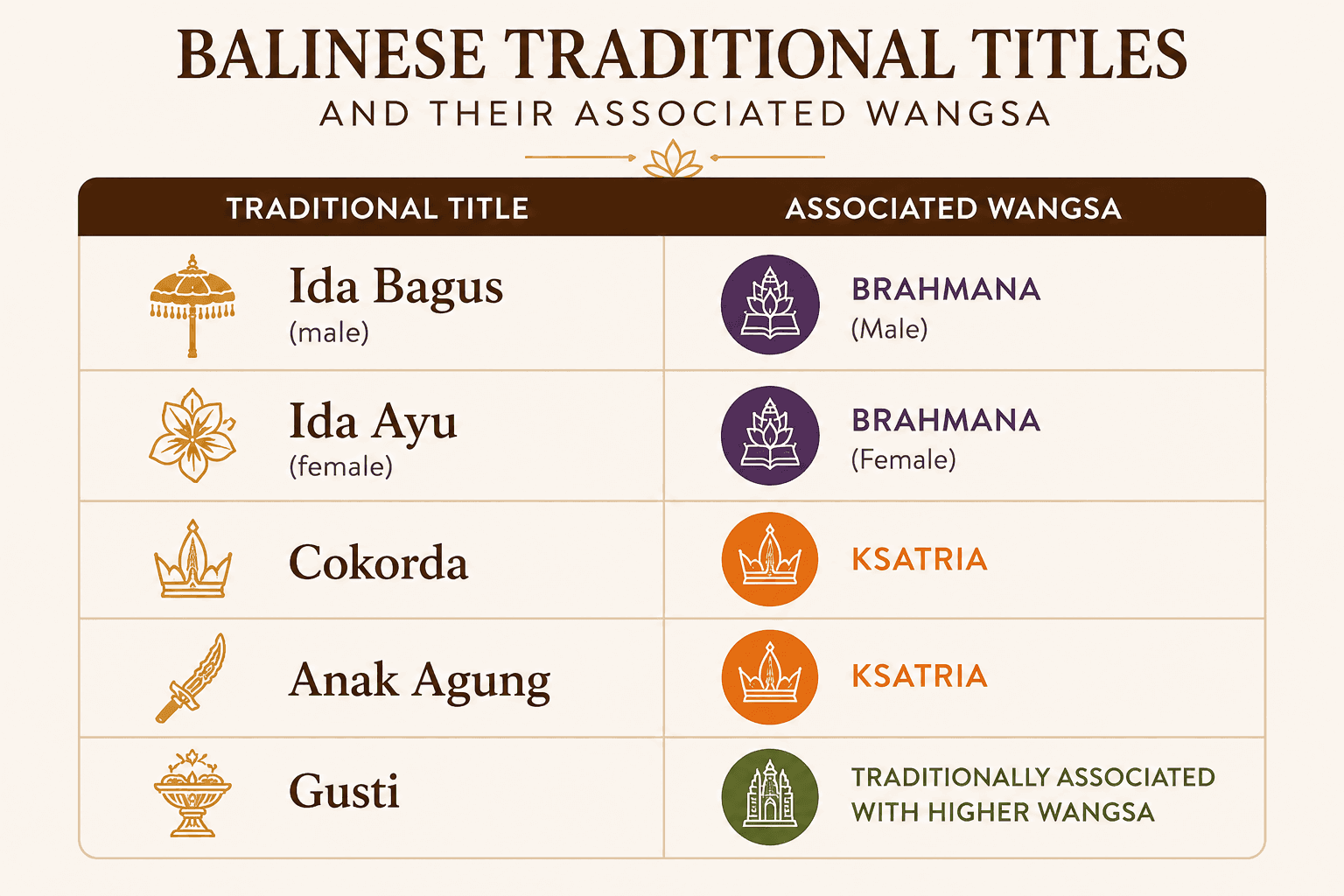
Their traditional names often include titles such as Ida Bagus (male) or Ida Ayu (female).
Does Wangsa Still Matter in Modern Bali?
Yes, but mostly in cultural and ceremonial contexts.
For everyday life, education, business, and friendships, wangsa plays a much smaller role than many visitors expect.
Modern Bali is a dynamic society where people work together regardless of family lineage.
However, wangsa may still influence:
- Religious ceremonies
- Temple etiquette
- Traditional family customs
- Marriage traditions
- Certain forms of respectful address
Many younger Balinese place far less emphasis on wangsa than previous generations, particularly in urban areas such as Denpasar.
Marriage and Family Traditions
Marriage is one area where traditional lineage can still play a role.
Historically, marriages between different wangsa were subject to strict customs and social expectations.
Today, intercaste marriages are increasingly common, especially among younger generations.
While some families may still value tradition, most marriages are ultimately accepted, and attitudes continue to become more relaxed over time.
Can You Tell Someone's Wangsa by Their Name?
Sometimes.
Many Balinese names include titles that indicate a family's traditional lineage. However, these titles only form part of a person's full name. Some common examples as shown in the table below:
If you've ever wondered why so many Balinese are called Wayan, Made, Nyoman, or Ketut, those names do not indicate caste.
Instead, they indicate birth order within the family.
👉 Learn more in our guide: Why Is Everyone in Bali Called Wayan, Made, Nyoman, or Ketut?
Understanding the naming system makes it much easier to appreciate how Balinese names are constructed.
Common Misconceptions About the Balinese Caste System
"People from different castes don't mix."
False.
Balinese from different wangsa work together, attend school together, become friends, and participate in community life together.
"The caste system determines how wealthy someone is."
False.
A person's economic status has little to do with their traditional lineage.
Successful entrepreneurs, professionals, and business owners come from every wangsa.
"Only Brahmana can become religious leaders."
While many Hindu priests come from Brahmana families, religious education, training, and dedication are also important.
Being born into a particular lineage alone does not automatically make someone a priest.
"Tourists need to know someone's caste."
Not at all.
Visitors are never expected to ask about a person's wangsa, and in most situations it simply isn't relevant.
Showing respect, dressing appropriately when visiting temples, and being polite are far more important.
Should Tourists Care About the Balinese Caste System?
It's worth understanding because it helps explain parts of Balinese history, religion, ceremonies, and naming traditions.
But you shouldn't worry about accidentally offending someone by not knowing their wangsa.
Balinese people are generally welcoming and don't expect visitors to understand every cultural tradition.
Instead, focus on showing respect for local customs:
- Dress appropriately when visiting temples.
- Follow your guide's instructions during ceremonies.
- Ask respectful questions if you're curious.
- Avoid making assumptions based on someone's name or title.
A genuine interest in Balinese culture is almost always appreciated.
Frequently Asked Questions
Is the Balinese caste system still important?
It remains culturally significant, particularly during religious ceremonies and family traditions, but it has much less influence over everyday life than many visitors expect.
What is the highest caste in Bali?
Traditionally, the Brahmana are associated with the priestly lineage. However, modern Balinese society generally places much greater importance on personal character, education, and community contribution than on lineage alone.
What caste are most Balinese people?
Approximately 90% of Balinese belong to the Sudra wangsa.
Can people from different wangsa marry?
Yes. Inter-wangsa marriages are common today, although some families continue to observe traditional customs.
Does everyone's name reveal their wangsa?
No.
Some traditional titles indicate family lineage, but the common first names Wayan, Made, Nyoman, and Ketut simply indicate birth order—not caste.
Final Thoughts
The Balinese caste system is one of the island's most misunderstood traditions.
While it shares historical roots with Hindu social structures, modern Bali has developed its own unique interpretation. Today, wangsa is primarily a reflection of family heritage and ceremonial tradition rather than a rigid social hierarchy.
For visitors, understanding this tradition isn't about learning who's "higher" or "lower." It's about appreciating the rich cultural history that has helped shape Bali into the island it is today.
The more you learn about Balinese customs—from naming traditions to temple etiquette and family ceremonies—the more meaningful your experience on the Island of the Gods will become.